

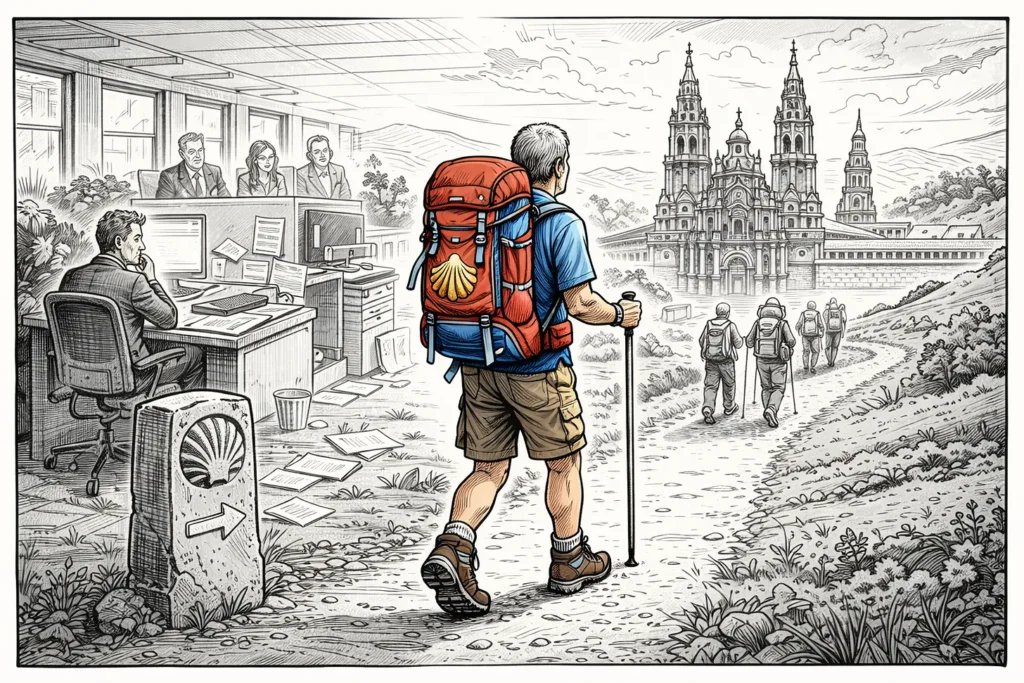
Last year, more than half a million pilgrims waled the Camino di Santiago, the highest number ever recorded. And among them, Australians are showing up in growing numbers, rising from just over 1,000 a decade ago to more than 7,000 a year now.
It would be easy to frame this as a travel trend, another box to tick, another curated experience. What I find interesting is that the majority of modern day pilgrims are in the 35–55 year old age bracket, which we might loosely term “midlife”.
And they are not going for adventure. They are going because something in them has shifted, and walking feels like the only honest response.
Departure
The poet David Whyte would say pilgrimage does not begin with a journey. It begins with a departure. Not the physical kind, but rather the internal one.
The moment you realise the life you’ve been living no longer fits, or that something you once believed about yourself (your role, your direction, your identity) has expired.
Midlife has a way of delivering these moments with precision. Careers that stop making sense. Relationships that change shape. The growing suspicion that you’ve been living a life that looked right from the outside but feels increasingly foreign from within.
You don’t always choose this departure. But eventually, you have to acknowledge it, and for many midlifers a pilgrimage is a way of working through that process.
The old roads are filling
Historically, pilgrimage was about devotion. Penance. Salvation. Today, it is something else.
The resurgence we’re seeing, from Spain’s Camino to emerging routes in Australia, appears less as being driven by religion and more by a search for meaning in a world that has become increasingly efficient, connected, and oddly hollow.
After COVID lockdowns, that craving intensified. The freedom to move, to wander, to be physically uncontained became something people felt in their bones. It is also increasingly about finding a way through.
Pilgrimage offers a structure that modern life no longer provides: Walk. Eat. Rest. Repeat. It is simple enough to be manageable, repetitive enough to be meditative, and demanding enough to matter. And for someone in midlife, where the problems are no longer solved by working harder, it offers a way to process life through a different lens.
Shelter from the storm
Whyte speaks of pilgrimage in terms of shelter. Not comfort, necessarily, but sufficiency. A place to rest. A meal. A bed. Nothing more.
This is where deeper recalibration begins. Midlife, for many, is defined by accumulation of responsibility, of complexity. Stuff. Pilgrimage strips all of that back. Everything you need is on your back. And very quickly, the question shifts from What do I want? to What is enough?
It turns out, not much. Fresh water. A hot shower. A shared meal. Maybe a conversation at the end of a long day.
And in that simplicity, something loosens. We begin to feel less burdened, not just physically, but psychologically. We begin to understand scale a little better, in that our immediate world becomes smaller, and more intimate.
Companionship
One revelation of pilgrimage is that you are never entirely alone. Even when you walk by yourself, you are part of a moving community. You fall into step with others.
It is transient. We are each on our own journeys, yet for a while our paths align. This changes the nature of conversation. There is less pressure to perform, and less need to impress. There is greater willingness to say what’s actually true.
Whyte suggests that sometimes it is strangers who can meet us most honestly, because they are not attached to the version of us we’ve been maintaining. On the road, you are not your job, nor your history, nor indeed your reputation. You are simply someone walking.
Friendship
Pilgrimage often changes how you understand friendship. On the Camino, or any long walk, friendships form quickly. They deepen fast. And then, often, they dissolve just as suddenly.
You walk together for days. Share stories you’ve never told. Laugh. Confide. Support each other through blisters and doubt. Then one morning, someone leaves earlier, or later, and the connection ends. No drama. No resolution.
Whyte sees this not as loss, but as a necessary transformation. Not all friendships are meant to last. Some are meant to change you, and then let you go. Relationships can be for a reason, a season or a lifetime, and each are just as valuable.
For people in midlife, who often cling tightly to long-established relationships, even when they’ve outgrown them, this introduces a different way of relating. There is less ownership and perhaps more presence, coupled with a deeper respect for the role someone plays in your life, even if it is temporary.
Aussies on tour
Australians, it seems, are increasingly open to this experience. Once a niche pursuit, pilgrimage has become a meaningful option for those seeking clarity in midlife.
Not just overseas. The Aussie Camino, stretching from Portland to Penola, offers a local expression of the same instinct: to step out of ordinary life and into something more deliberate.
There are no medieval cathedrals at the end. No centuries-old infrastructure. But that may not matter, because the real destination is internal. Your value is internal.
The deeper journey
Whyte writes that the pilgrim follows a path that is both visible and invisible. An outer road, marked by kilometres, alongside an inner one, marked by attention. The outer journey is straightforward. Wake. Walk. Arrive.
The inner journey is less predictable. The work of a pilgrim is to be surprised. It may involve:
- Letting go of identities that no longer fit
- Facing questions you’ve been avoiding
- Learning to trust something quieter than ambition
You may experience none of these things, but it is likely that, at some point, something shifts. The walking becomes less about getting somewhere, and more about being where you are. We may find that, all along, we already had what we needed from the beginning, we just couldn’t access it. This is a pilgrim’s journey.
Midlife as Pilgrimage
Seen clearly, midlife itself has the structure of a pilgrimage. There is a departure from the first half of life. A search for shelter, to better understand what sustains us now. A re-evaluation of companionship, in terms of who walks with you, and how. And an ongoing transformation of friendship, both with others, and with yourself.
The physical journey simply gives shape to something that is already happening. It makes the invisible visible.
The Return
Every pilgrimage ends where it began. You come home (ah that tricky word). Same house. Same life. Same responsibilities. But something has shifted.
Not dramatically. Not in a way you can easily explain. But enough, enough to let go of something that no longer serves. Enough to have a harder, more honest conversation. Or perhaps enough to choose a different direction, even if it’s a small one.
Whyte reminds us that every arrival is also another departure. That every new beginning comes from some other beginning’s end. The real question is not what you found on the road. It is what you are willing to carry back.
Why It Matters Now
We live in a world that encourages constant motion, but very little reflection. Pilgrimage reverses that. It slows you down enough to notice your own life. And for those in midlife, that may be its greatest gift. Because this is the moment when you can see the patterns and recognise that you still have time to change them.
Maybe this is why the roads are filling again. Not with tourists, but with people who are finally ready to leave, and in doing so, find a more honest way to return.
But your loss brought you here to walk
under one name and to walk under one name only,
and to find the guise under which all loss can live;
remember, you were given that name every day
along the way, remember, you were greeted as such,
and treated as such, and you needed no other name;
other people seemed to know you even before you gave up
being a shadow on the road and came into the light,
even before you sat down,
broke bread and drank wine,
wiped the wind-tears from your eyes:
Pilgrim they called you again
and again. Pilgrim.
– Excerpt from the poem ‘Camino’ by David Whyte
