
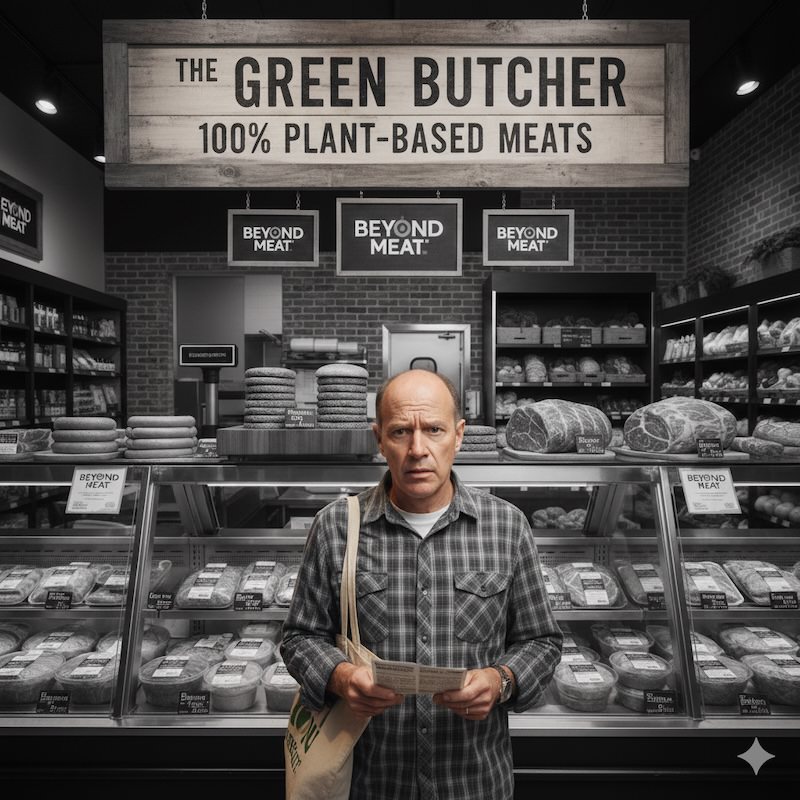
A few weeks ago, I found myself in a familiar Aussie scene: standing in front of the butcher’s counter, eyeing up a rack of lamb that could feed a footy team. Beside me, a bloke in hi-vis ordered a sausage roll “for the road.” And somewhere in the back of my mind, I am recalling a flyer from the Heart Foundation gently reminding me that perhaps, just perhaps, I might want to ease up on the red meat.
This, in a nutshell, is Australia in 2025: we love our meat pies, our weekend barbies, and the great national myth that “you haven’t eaten until you’ve had steak.” Yet, at the same time, veganism and vegetarianism are no longer fringe ideas. They have entered the mainstream.
How many Aussies
According to Roy Morgan research, around 2.5 million Australians now identify as vegetarian or mostly vegetarian. That’s roughly one in ten of us. The number of vegans, those brave souls who have banished cheese toasties and Magnums from their lives, sits lower, at around 1–2% of the population. But the bigger story isn’t the diehards. It’s the rise of the flexitarians: people who are consciously cutting back without cutting out.
Flexitarians still eat meat, but are consciously cutting back, especially when it comes to processed meats including sausage, bacon and deli meats. Why? Because there is strong evidence of a link to cancer when consumed regularly (let that sink in). For some, meat is simply becoming unaffordable.
The ethical plate
Let’s not skirt the obvious: the ethics of eating animals is uncomfortable territory. Most of us don’t want to dwell on abattoirs while tucking into a Parma. But the fact remains, modern farming often treats animals less like living beings and more like production units. Veganism, in its original spirit, wasn’t about being “better than thou”. It was about reducing harm where possible.
The environmental case
Even if you don’t lose sleep over animal welfare, the planet does. Meat and dairy production accounts for around 14–15% of global greenhouse gas emissions, roughly the same as all the world’s cars, planes, and ships combined. In Australia, where cattle farming is a backbone of rural life, livestock are also a major contributor to methane emissions (70 – 120 KG of methane per year). That’s a lot of cow burps.
Switching just part of our diets toward plant-based foods is one of the simplest climate “levers” available to individuals. Unlike buying an electric car or installing solar panels, it doesn’t require a bank loan or a tradie, just a different choice at the checkout once in a while.
The “Beyond Meat” problem
So why aren’t more of us making the shift? In a recent article for the Financial Times, Henry Mance pointed out that veganism has run into a marketing problem. Beyond Meat and its cousins promised a future where the burger tasted the same, only better for the planet. For a while, it worked. Investors piled in. Celebrity chefs endorsed it.
And then came the backlash. Suddenly, “plant-based” was (wrongly) conflated with “ultra-processed.” People worried less about methane and more about mysterious ingredients they couldn’t pronounce.
Never mind that plenty of the food we already eat – soft drinks, frozen pizzas, half the supermarket snack aisle – falls into the same processed category. Somehow, the veggie burger copped the blame.
There’s also a cultural wrinkle: Australians don’t like being told what to do. A Beyond Burger might be healthier than a beef burger, but if it feels like a lecture in a sesame-seed bun, we’ll politely decline and head for the steakhouse.
The hippo and the lion
There is also a perception problem, that somehow a vegetarian diet isn’t healthy. Try telling that to Aussie cricketer Peter Siddle, Sydney Swans legend Luke Parker, or paralympic basketballer Sarah Stewart. Vegetarians and / or vegans, and still living life to the full.
Yet still the perception continues, best summed up by a South African friend who consistently points out that hippos are herbivores (and fat), and lions are carnivores (and slim). Fair call but still. I am neither, so what about us humans? Well… we’re the flexible omnivores with the awkward choice about whether or not to pick up the veggie skewer at the barbecue.
Food for chat
But before anyone feels judged: this isn’t about giving up chuck steak forever. It’s about curiosity. Could you swap a veggie curry into your food choices once a week? Try oat milk in your flat white? Maybe chat to that friend who’s vegetarian, not to mock them for missing out on schnitzels, but to genuinely ask what keeps them going. The conversation isn’t about purity. It’s about balance, health, and maybe even, dare we say it, a little humility.
A MINDful diet
Here’s a thought: rather than “vegan” or “omnivore,” what if we thought in terms of a MIND diet, a Mediterranean-inspired, plant-heavy, flexible way of eating that is linked to better heart health, sharper cognition, and, yes, a lighter footprint on the planet. It’s not about strict rules, but about tipping the scales gently toward plants, nuts, and whole grains.
Veganism was intended to benefit not just the individual but society as a whole. The trouble is, it seems that many of us can’t quite be bothered. Fair enough. But maybe, just maybe, we could be slightly more bothered. Not to convert. Not to shame. But to give our future selves, the ones who want to stay sharp, fit, and connected, a bit of a fighting chance.
Don’t let the old man in.
