
Episode 08: Erin Buttermore
Why successful men at midlife still feel like frauds: Erin Buttermore
AIRED: 2/12/2025
Watch the episode
Introduction
You’ve climbed the ladder. Built the career. Earned the respect. So why does that voice in your head keep whispering you don’t deserve it? That any moment now, someone’s going to figure out you’ve been faking it all along?
If this sounds familiar, you’re far from alone. Research shows that 62% of knowledge workers experience imposter feelings, yet men are significantly less likely to talk about it or seek help. For blokes navigating midlife transitions, these feelings can hit particularly hard during career shifts, promotions or when contemplating retirement.
In this conversation, we sit down with Erin Buttermore, a strategy consultant, executive coach and PhD candidate researching the imposter phenomenon at the University of Sydney. Erin brings a refreshingly practical approach to what’s often called “imposter syndrome”, but she’s quick to correct that term. It’s not a syndrome at all, she explains. Calling it that pathologises a completely normal human experience and puts all the blame on the individual.
What we explore in this episode
The conversation challenges some deeply held beliefs about confidence, competence and masculinity. Erin explains how men socialised to equate confidence with competence often interpret self-doubt as proof they’re not ready, when in reality these feelings are simply the price we pay for growth beyond our comfort zone.
Key insights include:
- Why “imposter phenomenon” is a better term than “imposter syndrome” and what that shift in language reveals about the real problem
- How men at midlife experience self-doubt differently from women, often withdrawing rather than doubling down on perfectionism
- The toxic role of meritocratic culture in reinforcing feelings of fraudulence
- Why successful people attribute wins to luck and losses to personal failure
- The surprising link between stereotype threat and imposter feelings
- Practical techniques for managing automatic negative thoughts in real time
- How organisations, not just individuals, need to address impostorism
The conversation gets wonderfully practical when Erin shares a simple body-based technique for managing those moments when self-doubt strikes in high-stakes situations. No hot yoga studio required, just awareness of your feet in your shoes and three deep breaths.
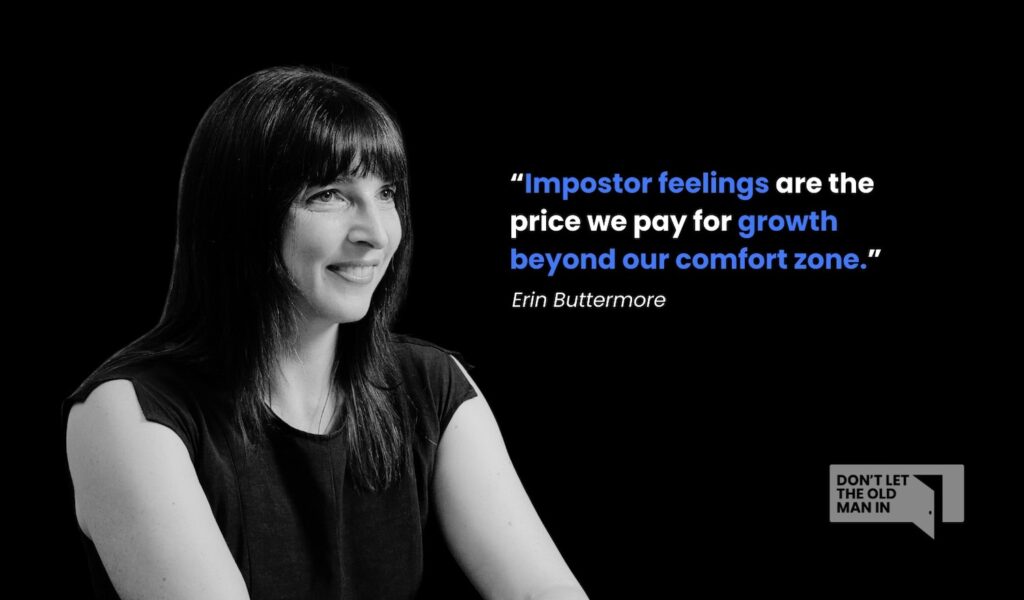
Perhaps most powerfully, Erin reframes imposter feelings not as evidence that something’s wrong with you, but as proof that you’re stretching yourself. “Imposter feelings are the price that you pay for growth beyond your comfort zone,” she explains. If you’re not feeling at least some self-doubt, you’re probably not challenging yourself enough.
For men approaching or navigating retirement, this episode offers valuable perspective on identity shifts, purpose and reinvention. The skills that got you here won’t necessarily get you there. The question is whether you’ll let self-doubt stop you from discovering what’s next, or recognise it as a natural part of the journey.
This is a conversation about giving yourself permission to be a learner again, to not have all the answers, and to trust that you’ve earned your place at the table, even when that three o’clock in the morning voice tries to convince you otherwise.
Guest info

Erin Buttermore is a Hobart-based strategy consultant and executive coach with more than 20 years’ experience spanning export trade, international relations, climate change, tourism, education and skilled migration across the public, private and non-profit sectors. She holds a Master of Science in Coaching Psychology from the University of Sydney, an MBA in Policy Management and is a certified vinyasa yoga teacher.
Currently pursuing PhD research at the University of Sydney with Dr Gordon Spence and Dr Michael Cavanagh, Erin is investigating how perceived organisational support and psychological capital relate to the imposter phenomenon. Her work challenges the prevailing view that impostorism is an individual flaw, instead framing it as a systemic, organisational issue that demands more nuanced and evidence-based interventions. Erin’s coaching practice integrates cutting-edge research, practical leadership experience and mindfulness-based approaches.
Support
There are a few simple ways you can support the show and the content we strive to craft and share every single week.
- Subscribe & Review: Please make sure to review, share comments and subscribe to the show on the various platforms (Apple, Spotify, YouTube, Facebook and Instagram) This helps tremendously!
- Spread The Word: Help grow our reach by sharing your enthusiasm for the podcast and/or your favourite episodes by posting about it on social media.
- Thanks To Our Team: No one person is an island. Our team at The Wisdom Vault are amazing! Hats off to Stephen Keys, my co- founder, Kevin Best, our Creative Director, Osh O’Sullivan for all things editing, Devon Creasman for all things marketing and community. Vernon Song and the team at Phlow, for all things website and branding. Sinead and the team at 2Cents for keeping our books on track. Hamish and team for Apparition Media for our amazing ‘Laughing Dads’ mural.