

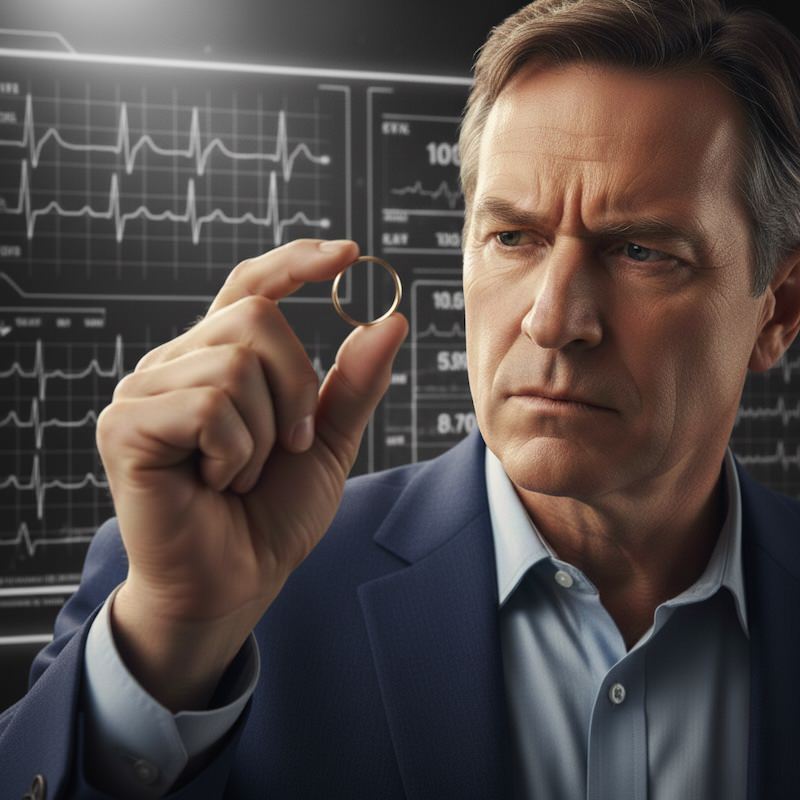
Lately, I’ve been noticing something interesting. Whenever I attend a conference on healthy longevity or sit in on a talk by a researcher who seems determined to help us outrun entropy, there’s a subtle glint on nearly every hand in the room. Professors, physicians, biotech founders. All sporting a slim metallic band that, if you didn’t know better, might look like a wedding ring from the future.
That subtle flash of titanium is a new type of wearable device, and has become the new academic endorsement. It is the unspoken badge of commitment to “knowing thyself,” one biometric at a time. I figured if the people who actually study aging were all wearing one, I probably should too. So, I joined the club.
After a month with the Ultrahuman Ring AIR, alas I’m not yet immortal. But I am marginally better informed, slightly better rested, and occasionally chastised by a gadget small enough to fit on my finger. Here is what I discovered along the way.
When the Scientists Start Wearing Rings
My curiosity really ignited during a presentation by Professor Andrea Maier, a leader in the healthy longevity field, who spoke about the value of continuous self-monitoring. Her message was simple but persuasive: you can’t manage what you don’t measure.
She wasn’t selling anything; she was simply pointing out that wearables bridge the gap between medical research and daily life. They translate abstract ideas about stress, recovery, and sleep into small, actionable nudges. Wearables encourage us not to learn from theories, but from feedback loops.
It made sense to me, and seeing so many serious scientists wearing rings rather than watches was, in its own way, an endorsement. Rings are subtle. You can wear them to bed, not something you can say about the oversized Garmin Fenix 8 watch. You can wear them in the shower, although I don’t because it’s weird. You can wear it even while pretending not to care about your metrics at a dinner party, although it occasionally makes for a fun topic of conversation.
So I ordered one.
The Sizing Kit Dilemma
I went with the Ultrahuman Ring AIR because, unlike the Oura, it didn’t compel me to take out a subscription (at least for core features). It’s slightly cheaper and lighter. It’s also the new kid on the block, meaning the accessory / support ecosystem is not quite as advanced.
Ultrahuman offers a free sizing kit by post, a small packet of plastic ring gauges that let you test fit before your real one ships. Thoughtful, yes. Environmentally, not great. The idea of flying a handful of plastic loops around the world so I could measure my finger felt wasteful, especially for something that’s meant to help me live more mindfully.
In the end, I skipped the mailing option and went into a local Harvey Norman store in Singapore to be fitted. Five minutes with a helpful assistant and a sanitised tray of rings later, I had my size plus and the quiet satisfaction of avoiding unnecessary packaging guilt.
Setup: Remarkably Simple
Once the ring arrived, setup was a breeze. The Ultrahuman app greeted me like an eager life coach: pair device, calibrate sensors, start tracking. Within minutes, it was measuring my heart rate, body temperature, and readiness, concepts that sound nebulous until they’re translated into coloured bars and percentages.
It’s surprisingly light, just a few grams, and comfortable enough that I forget I’m wearing it most of the time. The only reminder comes when an alert pops up on the phone, politely informing me that I’ve been idle too long or that my “recovery score” has dipped after a late-night Netflix relapse. The alerts are, of course, configurable.
Growing Used to the Gaze
After a week, I realised the ring had quietly inserted itself into my daily routine. Morning coffee now comes with a quick glance at last night’s sleep score. I might take a sneak peek at my sleep debt. And yes, that is where it can feel a little judgemental.
It doesn’t nag like a smartwatch, but instead delivers the kind of coolly objective truth that stings a little. “You only achieved 45 minutes of deep sleep,” it says, as if reading out a disappointing report card. Or, “Your caffeine intake may affect tonight’s recovery.”
There’s a temptation to argue with it, to insist that I’m different, more resilient, that my espresso after lunch doesn’t count. But the ring is unmoved. It deals only in data. You either learn to manage your reaction to it, or you spend your mornings negotiating with a piece of jewellery. Your choice.
A Mirror More Than a Monitor
What I’ve come to appreciate is that the ring doesn’t tell me anything revolutionary. I already knew sleep mattered, that too much caffeine messes with circadian rhythm, that stress accumulates invisibly.
What it does is make the invisible visible. Seeing those trends charted in an app gives the abstract a kind of moral weight. My sleep efficiency dropped 15 percent the night I stayed up writing this article; my resting heart rate climbed after a heavy meal; my body temperature rose subtly during a stressful week. It’s the difference between “I think I’m tired” and “The data says I’m running a deficit.” And that shift, from vague feeling to tangible evidence, changes behaviour.
For example, I now treat bedtime less as a vague suggestion and more like an appointment with my future self. I have adjusted the bedroom temperature to help sleep better. I get up for short walks and a little light stretching throughout the day. I keep an eye on things.
Sleep, Caffeine, and Other Small Miracles
If you strip away the science-speak, the Ultrahuman Ring AIR is profoundly simple in its utility. It helps regulate the basics:
- Sleep: It identifies not just how long I sleep, but the balance between deep, REM, and light stages. After nights when my deep sleep plummets, it gently pushes me toward earlier lights-out.
- Caffeine: It tracks when I drink coffee and how that timing correlates with reduced recovery. I’ve reluctantly accepted that my beloved 3 p.m. espresso was costing me the calm I’d been chasing at 10 p.m.
- Movement: It nudges me out of sedentary stretches with quiet dignity. No shaming, just subtle awareness. Still my choice.
None of these are new habits, but the data lends them structure.
Not Built for Olympians
If you’re a serious runner, the Ring AIR isn’t your soulmate. It doesn’t have GPS tracking, pace analysis, or the kind of real-time data you’d get from a Garmin. Its activity recognition is general and not particularly accurate.
That said, for general fitness awareness, it’s perfectly adequate. It tracks rough distance, calories burned, and heart rate trends with reasonable accuracy. For the rest of us — those trying to stay generally alive and vaguely functional — it’s more than enough. For the competitive athlete, this ring would likely be the sidekick, not the coach.
Living With a Digital Conscience
What I didn’t expect was how quickly the ring would change the tone of self-reflection. It’s like having a pocket-sized behavioural scientist perched on your finger, whispering gentle truths about your biology. And I am now more actively interested in topics like “brain waste clearance” and what I can do to improve my score, which seems like a worthwhile pursuit.
The trick is not to become enslaved by it. Data is helpful; obsession is not. If my recovery score is low, I don’t cancel my day, I just interpret it as a reminder to breathe, hydrate, maybe skip that late-night scrolling session. Wearables can become tyrants if you let them. But managed wisely, they’re mirrors: honest, unemotional, and useful. Nudge theory in action.
The Fifth Pillar
Diet, sleep, exercise, and social connection form the foundation of long-term health. The emerging “fifth pillar” is self-awareness, and that’s where wearables make a real difference.
Whether its diet and metabolism, sleep, exercise, social connection or accountability, wearables turn intuition into insight. You stop guessing how well you’re sleeping, recovering, or eating, and start seeing patterns tied to your habits, stress, and social rhythms.
Used wisely (not obsessively), they can help you close the gap between what you feel and what’s actually happening in your body.
A Month In: The Verdict
After a month, the Ultrahuman Ring AIR has proven quietly transformative. It hasn’t turned me into a monk, but it has nudged me toward better rhythms. Earlier nights, more movement, fewer mindless coffees.
I’ve grown used to its presence, almost fond of its small reprimands. The data it provides isn’t about chasing perfection; it’s about cultivating awareness. Stress, as Professor Maier reminded us, is not the enemy. The enemy is failing to recover.
And that’s where the ring earns its keep, by translating theory into tangible feedback. It’s not glamorous. It’s not perfect. But it’s enough to make you pause before pouring that second coffee, or to choose an early night over one more episode.
In the grand scheme of longevity, maybe that’s what we need: tiny, daily interventions that keep the old man waiting outside just a little longer. I think I will keep wearing my ring for a while longer yet.
