

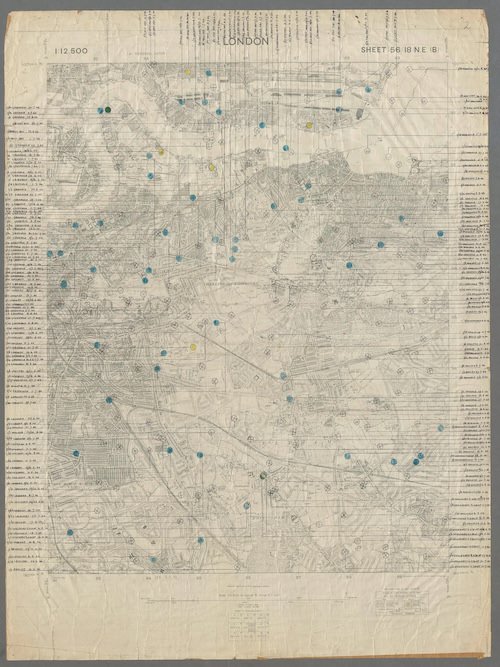
There is a particular kind of silence that lives in archives.
Not the reverent hush of a cathedral, or the anticipatory quiet before a performance, but a deeper, heavier stillness. The silence of things that happened and were survived.
My brother and I found that silence in the British National Archives. Folders. Maps. Typed forms. Handwritten notes. Grid references. Times recorded to the minute. A bomb. A house. A boy.
Mascall Road, Greenwich.
27 July 1944.
19:30.
A doodlebug, a V-1 flying bomb, came down on the house next door. My father was a child. He survived. The boy next door didn’t.
This is not a story about heroics in the cinematic sense. There are no speeches. No swelling music. No medals pinned to chests. It is a story about stoicism, the unglamorous, grinding endurance that history rarely celebrates but quietly depends upon.
What the records say
The paperwork is meticulous. The bomb census form lists the size and type of bomb. Notes the absence of a crater. Describes damage to eight houses. Mentions “some Anderson shelters damaged,” as though that phrase could ever capture what it meant to dig a child out of the earth by hand.
Distances are measured. Frontages recorded. Initials added by men who likely went home, ate dinner, and returned to do it again the next night.
There is no space on the form for terror. No column for grief. The document is sparse. There is space on the form for casualties, but it’s not filled in.
We can speculate about the conditions in which those involved tried to fulfill the task of keeping accurate records, balanced against the confusion and pressure of the moment. Maybe it was considered better to leave a space than to record something unconfirmed and potentially inaccurate. Maybe it is left to historians to piece together the fragments of a much wider picture.
The boy who died.
A brother, pulled from the shelter, badly injured.
My father, hospitalised.
A skull shattered enough to require a bone graft. Experimental at the time, especially for a child.
Dad would spend long periods separated from his family while his body healed and his parents did what parents in wartime Britain did: carried on. His father worked in a factory by day and served as a night watchman after dark. There were no options. There was work, duty, and whatever sleep could be stolen between sirens.
Stoicism does not announce itself. It does not posture. It simply keeps moving forward.
Stoicism Is not what Instagram thinks it is
Modern culture has a habit of flattening stoicism into a slogan.
“Man up.” “Grind harder.” This is not stoicism. This is emotional illiteracy dressed up as strength.
Real stoicism, the kind practiced by people who didn’t have the luxury of philosophising about it, is quieter and far more humane. It is the discipline of accepting what cannot be changed, while still taking responsibility for what can.
My father did not choose to be bombed. He did not choose to be injured, separated, or altered by events that would echo through his life. What he did choose, or perhaps what was chosen for him by circumstance, was endurance.
The stoics spoke of amor fati: love of fate. Not passive resignation, but the refusal to be broken by what arrives uninvited. There is a difference between being hardened and being hollowed out. The former can still carry meaning. The latter cannot.
The administrative miracle
One of the most striking things about the archive material is not the violence it records, but the order it insists upon.
Even while cities burned, someone drew careful lines on a map. Someone recorded grid references. Someone ensured that damage was categorised consistently. This was not bureaucracy for its own sake. It was civilisation holding the line.
Administrative discipline is an underrated form of moral courage. It is the belief that even in chaos, truth matters. That facts matter. That tomorrow will need a record of today.
Stoicism is often misunderstood as emotional suppression. In reality, it is often expressed through structure.
You make the bed.
You fill out the form.
You show up for the shift.
You check on your neighbours.
You rebuild.
Not because you feel like it, but because not doing so invites collapse.
Childhood interrupted
We talk about childhood trauma now with language that is expansive, compassionate, and necessary. In 1944, there was no such vocabulary. There was just what happened , and what followed.
My father survived, but survival is not the same as being untouched. A damaged skull is not just a medical event; it is a lifelong reminder that the world can fracture without warning. Separation from family during recovery was not framed as emotional deprivation. It was framed as necessity. Beds were scarce. Parents worked. The war did not pause for feelings.
And yet, many of that generation emerged without bitterness. Not because they didn’t suffer, but because they learned early that suffering is not a personal injustice, it is a feature of existence.
This is a difficult lesson for modern men, raised on the promise that life should be fair, comfortable, and validating. History teaches otherwise.
Masculinity without performance
The men of that era did not talk much about their feelings — not because they were incapable, but because talking did not solve the immediate problem.
You cannot debate a bomb out of the sky.
You cannot therapise rubble into place.
You cannot process your way to structural integrity.
So they acted.
This is not an argument against emotional awareness. It is an argument against confusing expression with effectiveness.
Stoicism does not deny emotion. It simply refuses to let emotion dictate action. That is a lesson worth reclaiming, especially for men navigating midlife, where losses accumulate and illusions fall away.
You will not always get closure.
You will not always get explanations.
You will often be required to carry on anyway.
What my father never said
Like many of his generation, my father does not frame his life in terms of victimhood. Perhaps that is his way of protecting us, or more likely protecting himself from such memories. Or perhaps it was simply how he has been built by history, shaped by a time that demanded resilience without applause.
Stoicism, at its best, is not silence for silence’s sake. It is the ability to hold pain without broadcasting it, to integrate hardship into identity without being defined by it. There is dignity in that.
What my father does say, and what sits with me now, is that it’s not what happens to you that matters, but how you react that counts. As I survey these documents from the National Archives, I am only now just beginning to understand the meaning of his words.
Why this matters now
We live in an age of unprecedented comfort and unprecedented fragility. Small setbacks feel catastrophic. Discomfort is treated as danger. Resilience is often confused with bravado.
History offers a corrective. Not nostalgia. Not romanticisation. Perspective.
When you see a child survive a bomb, undergo experimental surgery, lose neighbours, endure separation, and still build a life, it recalibrates your sense of what is survivable. It does not minimise modern suffering. It contextualises it.
Stoicism does not tell us to be numb. It tells us to be proportionate.
The old man and the long view
The phrase Don’t Let the Old Man In, which we use for our podcast show, is not about aging. It is about refusing the slow erosion of courage, responsibility, and meaning. The “old man” is cynicism. Entitlement. The belief that life owes us comfort.
History teaches the opposite. Life owes us nothing. It is monumentally ignorant of our suffering. Instead, meaning is earned through how we respond.
My father did not choose his test. None of us do. But his life, like so many of that generation, stands as evidence that endurance is not loud, dramatic, or self-congratulatory. It is quiet, stubborn and indelibly human.
And sometimes, decades later, it is written in faded ink on yellowed paper, waiting for sons to read it and understand what was carried without complaint.
That, too, is stoicism.
And it is worth remembering.
