

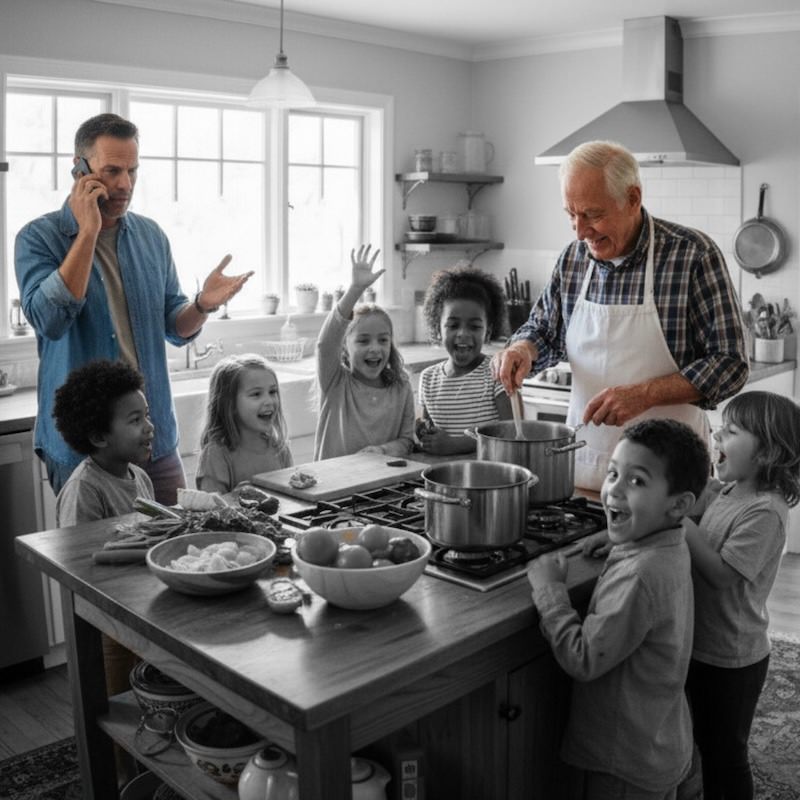
If you were lucky enough to grow up in Australia in the 1970s or 80s, you’ll remember grandparents as shadowy figures who occasionally turned up in beige cars, handed over a packet of Minties, and then disappeared back into the suburbs before anyone asked them to change a nappy. Their role was ceremonial, like a Governor-General with boiled sweets.
Fast-forward to today and you’ll find something quite different: grandparents are no longer ornamental extras, they’ve become the reserve army of society. Without them, the whole delicate infrastructure of Australian family life would probably collapse faster than England’s batting line up in the Ashes.
From “Nice-to-Have” to “Essential Services”
Once we may have held on to the idea to late life would be a chance enjoy our golden years, perhaps seeing the world from the comfort of a cruise ship, or gardening and playing bridge with friends. Today, grandparents are more likely to be driving SUVs full of booster seats, ferrying kids to footy practice, and cooking Tuesday-night stir fry while both parents sit on Teams calls.
Grandparents have become the unofficial childcare sector, filling the yawning gap between what families need and what the system provides. In fact, the Australian Bureau of Statistics show that nearly 40% of Australian children under 12 receive regular care from their grandparents. And let’s be honest: without them, a whole generation of midlife Australians (you and me) would be even more frazzled, less well off, and one flat white away from a nervous breakdown.
Our parents didn’t expect this gig. They’re the first generation to enter grandparenthood after two decades of “retirement as lifestyle” marketing, yet they’ve ended up more like Uber drivers with a Medicare card.
A glimpse of our future
Now here’s the uncomfortable bit: this is us in 15 or 20 years. We’re the ones who’ll be called on to pick up the grandkids from daycare, sign them into after-school care, or act as the emergency Plan B when someone has gastro and the parents can’t miss another day of work.
The irony is delicious. Many of us spent our 30s outsourcing as much parenting as possible—gym crèche, before-school care, homework clubs, Uber Eats. We’ve lived efficiency-driven lives. But in the next act, society will come knocking, and suddenly it’ll be our unpaid labour propping up the national economy.
The good news? It’s not a punishment. Done well, it’s actually one of the most rewarding roles we’ll ever play. But it does mean we should start planning for it now, before the little darlings even exist.
What we value most
Let’s face it, no one looks back and wishes they spent more time in budget review meetings. The moments we value most are human: time with our kids, our mates, our community. And increasingly, with our grandkids.
Research from beyond our shores backs this up. A UK study found that older people involved in grandchild care had better cognitive function and lower risk of depression. In Germany, they even measured that grandparents who helped care for grandchildren lived longer. It’s as if biology itself has designed us for this encore role.
But to enjoy it, we need to be clear-eyed about what matters. It’s not being available 24/7 or competing with YouTube for entertainment value. It’s showing up consistently, sharing stories, transmitting values, and making memories. In other words, presence over presents.
Putting in a shift
So how do we get ready for this inevitable conscription into the reserve army? A few thoughts from the front lines of midlife:
- Get Fit (Seriously).
Carrying toddlers, running after scooters, and sitting cross-legged on the floor requires a body that hasn’t completely surrendered to gravity. Future-proof yourself now. Pilates isn’t just for yoga mums; it’s for blokes who don’t want to put their backs out lifting a three-year-old. - Talk About It.
Our parents rarely discussed expectations. Many quietly fumed about lost freedom but didn’t say so. Let’s do better. Have a conversation with your adult kids early: “Here’s what we’re up for, here’s what we’re not.” Clarity beats resentment every time. - Set Boundaries (But Don’t Be Rigid).
It’s okay to say you won’t be available every weekend, or that Tuesday golf is non-negotiable. But remember flexibility is part of the job description. Emergencies happen. And let’s be honest: when a grandchild looks at you with Vegemite smeared across their face, boundaries tend to soften. - Keep Some Independence.
We value freedom more than anything, so preserve it. Plan your travel, your projects, your “third stage” purpose. Grandparenting works best when it’s part of a rich, balanced life, not a reluctant full-time job. - Laugh (At Yourself, Mostly).
Nothing keeps you sane like humour. Yes, the car seat will defeat you. Yes, you’ll end up at the wrong soccer field. Yes, you’ll discover that Bluey has more wisdom than most management consultants. Enjoy it.
Why it matters
Without grandparents, the Australian economy would face a childcare crisis even more dire than the one we already have. By stepping in, we not only support our families but also allow younger generations—our kids—to remain in the workforce, build careers, and keep the tax base from collapsing.
But it’s more than economics. Grandparents are keepers of continuity. They’re living proof to children that family is not just Mum, Dad, and an iPad. They embody resilience, culture, and the kind of patience that comes from surviving the Whitlam dismissal, the ‘87 crash, and the great toilet paper shortage of 2020.
The enjoyment factor
Let’s not forget: it’s fun. Grandchildren are like a second crack at parenting but with better judgment and less sleep deprivation. You get the joy without the existential terror of wondering if you’ve ruined them forever.
You also get to pass on the best bits—your stories, your secret barbecue sauce recipe, your music tastes (forget Bach for Babies, let’s teach them all about the genius that is Bob Dylan)—without the pressure of being their primary moral compass. And when the noise gets too much, you can always hand them back and pour yourself a quiet shiraz.
As my Mum and Dad like to say, if they knew how much fun grandkids would be, they would have had them first.
Final word
We Aussies pride ourselves on resilience and resourcefulness. Our parents have shown us what it looks like to step up when needed. The challenge for us is to enter that same stage not begrudgingly, but deliberately, with humour, health, and a clear sense of what we value.
Because when the call comes—and it will—none of us want to be remembered as the bloke who dodged the duty. We want to be remembered as the granddad who showed up, gave it a red-hot go, and enjoyed every second of it (except maybe the nappy changes).
The reserve army of society? Yes. But it’s likely the best unit you’ll ever have the privilege to join.
